
Floodwater Finds the Opening: The Design Challenge Hiding in Plain Sight
The building may be strong. The opening is where the flood gets in.
When people picture flood damage, they often imagine water overtopping a riverbank or surging across a parking lot. Facility managers tend to see the problem differently. They see the doors that must stay open for deliveries. The gate that allows emergency access.
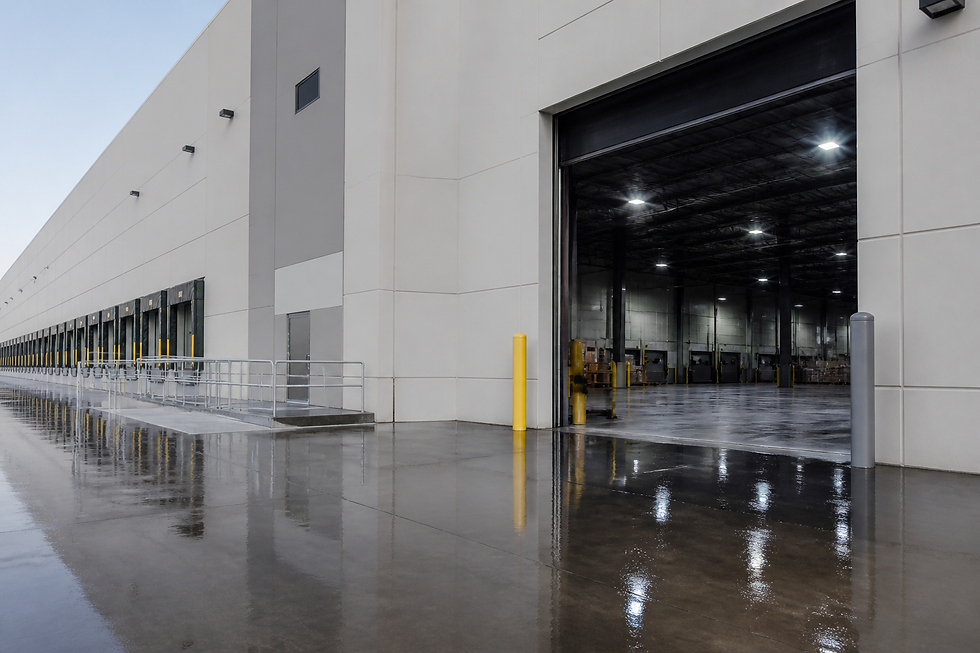
The loading dock built lower than the surrounding site. The service entrance that seemed harmless until water was moving across the pavement.
Floodwater does not need to defeat an entire building. It needs one path.
That is why openings deserve far more attention in flood-resilience planning. They sit at the intersection of protection and operations: essential to how a facility works every day, yet often the most direct route for water to reach people, inventory, equipment and critical systems.
Why openings create a different kind of problem
Walls can be raised, strengthened or moved outside the most exposed areas. Openings are not so easily solved. They must allow people, vehicles, materials and services to move. In a hospital, an entrance may support patient flow or emergency response. At an industrial site, it may support the process itself. At a public facility, it may be the route through which an entire community receives a service.
Closing an opening permanently may be impractical. Ignoring it may be worse.
The design challenge is to preserve normal access while creating a reliable means of protection when flood conditions develop. That requires more than placing a barrier in front of a door. The system must match the width, height, surface conditions, water forces and operational realities of the location. It must also be able to be deployed in the time available.
For that reason, facilities should avoid treating every opening as identical. A narrow personnel door, a broad loading dock and a vehicle access route may need entirely different approaches. The plan needs to begin with the role each opening plays when the facility is operating normally—and the consequence if water gets through it.
The hidden questions behind a visible risk
The obvious question is, “How high can the water get?” It is an important one, but it is not the only question.
Facility teams should also consider where water will collect, how it will approach the opening, whether wave action or moving water is possible, how the surrounding surface affects sealing, and what has to happen on the inside of the building if water reaches the threshold. Drainage, sump capacity, backflow, electrical equipment and internal routes can all shape the outcome.
FEMA’s non-residential floodproofing guidance is useful here because it emphasizes evaluation of conditions and selection of measures that fit the specific building and hazard. A barrier alone is not a universal answer. Its effectiveness depends on how it is designed into the site, how it interfaces with the opening and how the wider flood-protection system performs.

From weak point to working system
The best opening-protection solutions become part of an operating system rather than a one-time construction detail.
First, the vulnerable opening is measured and assessed. Then the barrier is configured for the site and the expected conditions. Storage and access are planned, because a system that is difficult to reach is a system that may not be ready. Finally, people practice the deployment process and understand their responsibilities.
That sequence sounds straightforward, but it addresses the reasons many flood plans fail under pressure. Components are stored in the wrong place. Teams do not know who can authorize deployment. A barrier is technically capable but does not fit around an unanticipated obstruction. A loading operation runs late and leaves the opening exposed just when protection is needed.
Deployable barriers are especially valuable where a permanent structure would interfere with daily use. A properly designed modular system can be stored when not needed, deployed across an opening when risk rises and removed after the event. For commercial and industrial sites, that flexibility can make flood resilience more compatible with the way the facility actually works.
At AquaFence, this is the principle behind engineered modular protection: a solution should not ask a facility to choose between operating normally and being prepared for water. It should support both.
A better conversation for architects, engineers and facility leaders
Opening protection is not merely a product-selection exercise. It is a coordination issue among the people who understand the building, the operational requirements and the flood hazard.
Architects and engineers can identify design constraints and interfaces. Facility teams can explain how people, goods and services move through the site. Emergency planners can establish warning triggers and deployment roles. Together, they can decide where permanent changes make sense and where deployable protection offers the most practical resilience.
The resulting plan is usually more precise—and more credible—than a generic floodwall concept. It can focus resources on the openings where failure would do the most harm.

Four details worth reviewing before the next storm season
The threshold: Is the interface suitable for a barrier and the expected water conditions?
The route: Can a deployment team reach the opening, even during disrupted operations?
The storage: Are components protected, identifiable and close enough to use quickly?
The inside consequence: What would water reach first if the opening failed?
Protection begins where the building opens
Flood resilience can seem abstract when it is discussed only in maps, standards and storm statistics. At the facility level, it becomes very concrete. It is the door, dock, gate or access route through which water can enter.
That is not a reason to accept disruption. It is a reason to design more intelligently around it. When vulnerable openings are understood, engineered and supported by a practical deployment plan, they can move from being the hidden weakness in a flood strategy to becoming one of its strongest points.
Learn how AquaFence FloodBarricade and modular barrier systems can protect large openings while preserving daily access.
---


